

The Main Chapel
The Main Chapel
The Main Chapel
Audio transcription
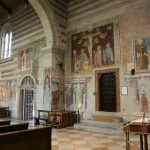
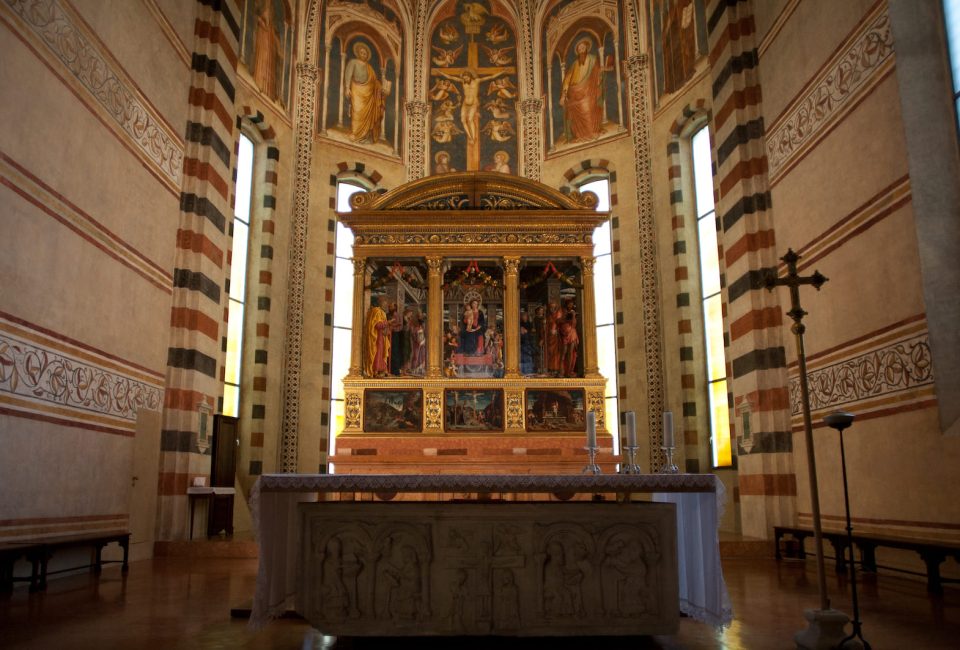
The chapel was built in the Gothic style between 1386 and 1398. The frescoes of the triumphal arch and apse, with the Annunciation on the external front and the Crucifixion on the inside, are attributed to Martino da Verona. The altar table supported by the sarcophagus of the Bishops Lucillo, Lupicinus, and the hermit Crescenziano, as well as the ambo, with a 14th century Annunciation, are the result of a modern reworking. The famous altarpiece by Andrea Mantegna is situated above altar.
The appointment of Mantegna by Abbot Gregorio Correr probably dates back to 1456; the work was completed by 1460. In addition to painting, Mantegna also designed the frame of the polyptych, and a separate area for the monks’ choir, to which the altarpiece, with its placement on the altar, would be the natural conclusion. He purposely made the window open on the right side of the apse so that the source of natural light would coincide with the one represented in the painting. He paid tribute to the Basilica by making reference to the Romanesque rose window in the representation of the halo above the Virgin, as well as under the carpet at her feet. The triptych remained in San Zeno until 1797, when it was transferred to France as Napoleonic booty. In 1815 it was returned to the city of Verona, but without the three predellas at the base, which are now housed in the Louvre and Tours Museums. Those seen within the piece today are 19th century copies. The San Zeno Altarpiece represents a Sacred Conversation. In a timeless peristyle we see the Virgin with Child and the Saints Peter, Paul, John the Evangelist and Zeno on the left, while on the right we recognise St. Benedict, St. Lawrence, St. Gregory and St. John the Baptist. In the background one can catch glimpses of a natural landscape clearly derived from the Veneto region. Each saint appears absorbed in his own reflection on the mystery of the Incarnation, but the innovative and revolutionary aspect of this great wooden altarpiece lies in its unity. The upper three panels, although distinct, form a single large painting. The architecture accentuates the illusion of perspective, the light pervades the scene as if in a single setting that reaches its conclusion in the gilt frame; an ideal continuation of the open gallery. A recent restoration has brought to light a series of sketches, annotations and notes under the frame. These were made by Mantegna himself during the course of his work. The original brilliance of the colours has returned as a result of cleaning, and has highlighted Mantegna’s calling to the three-dimensional, which is inherent in his painting. One sees, for example the beauty of the drapery. This can perhaps be ascribed to his apprenticeship as a youth in Padua, where Donatello worked at the time. The Altarpiece of San Zeno was crucial to the career of Andrea Mantegna as the encounter with Gregorio Correr, who commissioned the work, and who is represented here in a portrait similar to that of Gregory the Great, marked the start of an important friendship that would introduce him to the court of the Gonzagas in Mantua.