
The Lower Church
The Lower Church
The Lower Church
Audio transcription
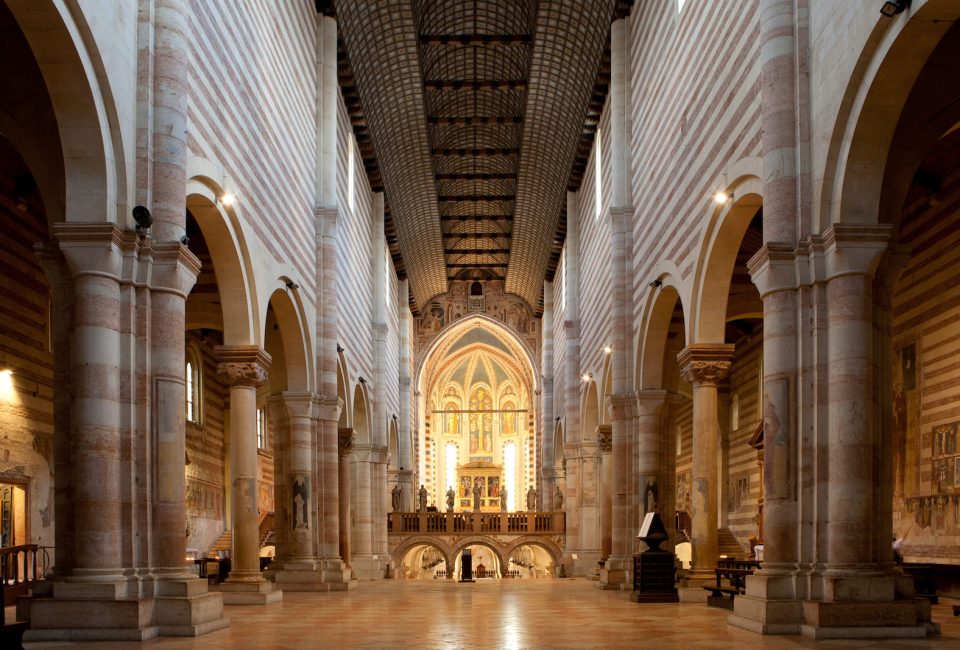
The cloister leads to the Basilica from a side entrance. The interior is subdivided into three levels: The main church, which is divided by massive columns that alternate with multi-lobed columns; the crypt, where a forest of columns with imaginative capitals guard the body of St. Zeno, and the presbytery, which is dominated by Andrea Mantegna’s imposing and celebrated altarpiece. This subdivision represents the mystical expression of three symbolic churches: the Militant, the Purgative and Triumphant Church.
To have a perfect view of the harmony of the Romanesque style, it is recommended that you position yourself on the steps of the main entrance. As you descend, on your right you will see the great 14th century crucifix by Lorenzo Veneziano and the octagonal baptismal font sculpted by Brioloto between 1217 and 1225 AD. In the left corner is the great porphyry cup, a monolith of Roman times from a thermal bathhouse. According to popular legend, it was donated to St. Zeno by King Gallienus and then transported here by a demon that lost a bet with the saint. This corner of the Basilica once housed the glorious standard-bearing cart deployed by the Veronese in battle, which was destroyed in 1583. Along the right wall you can admire a series of 14th and 15th century votive frescoes. There is also an impressive 12th century St. Christopher, and, further to the right, a series of stories about St. Nicholas of Bari from the 14th century. Along the left aisle you will notice an interesting fresco of “The Last Supper” in which scorpions, a symbol of betrayal, appear in the lavish feast. Above the door to the cloister there is a 14th century fresco depicting St. Zeno as he administers baptism, and immediately to the right of the door, there is a baroque altar with the Pietà painted onto the soft stone.