
The Façade
The Façade
The Façade
Audio transcription
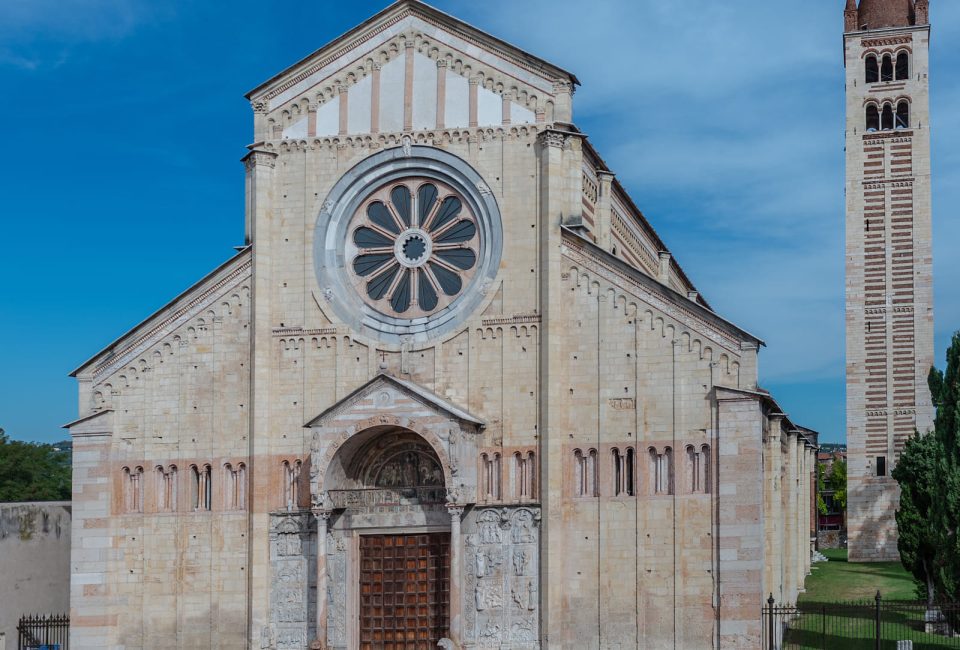
The façade, enclosed on the left by the abbey tower and on the right by the belfry, appears in all its beauty and splendour thanks to skilful restoration work. Tuff alternates with local marble. Under the gable, recent works have brought to light a Universal Judgement scene engraved in the stone. The 13th century rose window is the work of sculptor Brioloto who, with the help of Adamino da San Georgio, decorated it with a series of allegorical sculptures of an alternating human story.
Unlike “The Wheel of Fortune,” they are not arranged randomly. The first figure is a man on a throne. He falls, continuously crushed by misfortune, then recovers and rises. Fortune, conceived and represented as such, highlights the precariousness of earthly treasures. It is a warning against having an excessive attachment to worldly goods, as we can lose them at any time. Only a fool trusts solely in fortune, and his fate is to be held in derision. Two column-bearing lions support the porch made by Nicholaus’ workshop in approximately 1138 AD. The sculptor created the marble panels to right of the portal with stories of Creation (the Expulsion from Paradise, the Maternity and Work of the Forefathers, the Creation of Eve, Original Sin, the Creation of Animals, and The Creation of Adam) and two scenes related to Theodoric. To the left, his student, Guglielmo, attempted episodes from the New Testament including Judas’ Betrayal, the Crucifixion, the Flight to Egypt, the Baptism, the Magi, the Presentation in the Temple, the Nativity, the Visitation, and the Annunciation. On the left architrave: a bearded old atlas has been carved at the top of a single block of marble, sitting cross-legged while supporting the cornice on his back with his hands. His hands are on the outside, within arches that represent the months. December is symbolised by the carrying of firewood; January by a man sitting and warming himself by the fire; and February is symbolised by a pruner. On the inside, September is symbolised by a man pressing grapes; October, by the harvest of acorns for the pigs; and November is symbolised by the killing of a pig. On the underside of the block, a winged monster with the head of a goat has been carved. At the top of the architrave is a beardless atlas, crouching, and on the outside, the months are represented within arches set on small columns. There is the month of March, represented by a double horn player, April, by a girl holding a flower in her hand, and May, by a knight. On the inside, June is symbolised by a man picking fruit, July, by a reaper and August by a man repairing a barrel. The underside features a winged monster. The lunette space above the porch is decorated with a central plate that depicts St. Zeno giving a blessing. To the left there are two rows of soldiers armed with bows and swords walking and carrying a banner. To right, a group of knights can be seen.
The story of the church through the architecture and works of art